
Run clubs, queues outside the new restaurant, an Uber suscription-
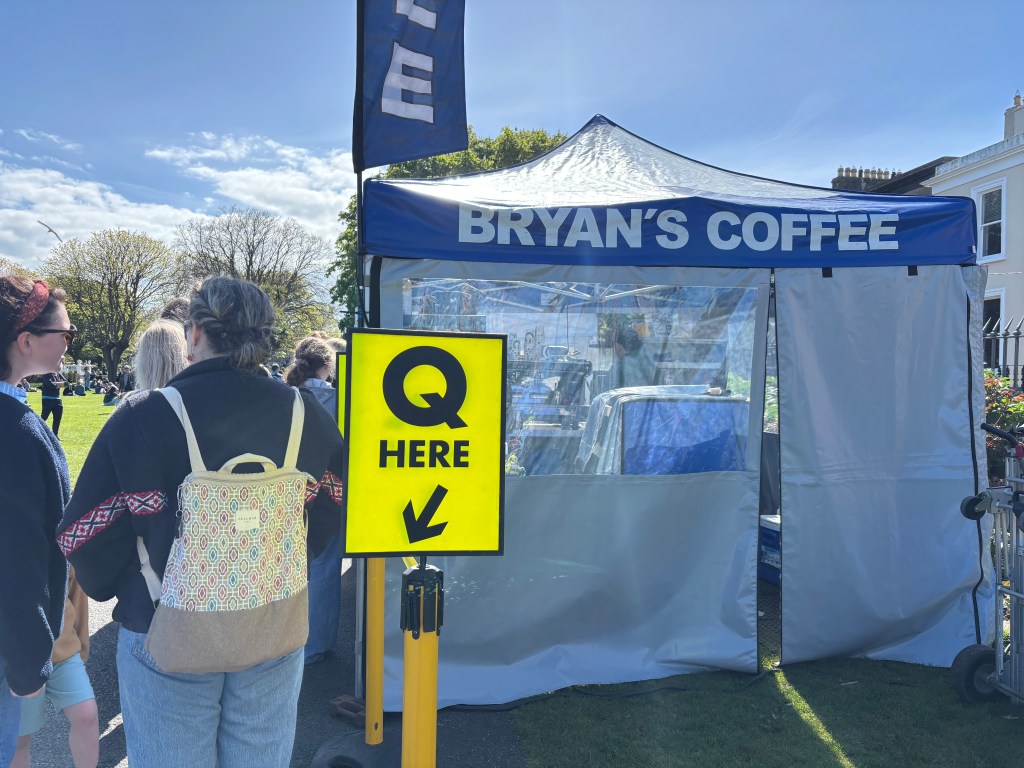
Ireland’s upper class demonstrates its wealth in the form of trends, leisure time, just as in the Regency era, a privilege. Elizabeth Bennet moves throughout her own story with the agency of someone in a favourable economic position, where behavior and movements work as markers of class distinction. This blog reimagines these dynamics within contemporary suburban Dublin, arguing that the class structures of Austen’s novel can be mapped onto the city’s spatial and social organisation. By examining the distribution of wealth across South Dublin, it becomes evident that class continues to operate through mobility, geography and selective social visibility. While some structure remain surprisingly unchanged, they are shown through modern practices of convenience.
D18’s Landed Gentry
Readers are lead to believe that the Bennet’s are not as financially secure, constantly positioned as socially inferior to figures such as Bingley and Darcy, but, as Hume points out, “Mr Bennet’s 2000 pounds falls in the top one-fifth of 1%” (289). This makes him a top-earner in regency society. The Bennet’s are not impoverished outsiders, but members of the landed gentry; economically stable, but socially vulnerable due to the absence of a male heir. This distinction is crucial when translating their situation into a contemporary context. While it is tricky to determine what this income would be in our times, “the retail price index method gives him an annual income of approximately 200,000 pounds” (Toran). So the Bennet’s are well off, and would still be today, even regarding the inflation and recession. But where would they be, and how would they live, if translated into our modern Ireland?
Reimagining these dynamics within Dublin and its suburbs reveals a ‘progressed’ continuity in the spatial organisation of class. Wealth in Dublin is concentrated in the Southside, with the highest median gross household incomes on the Southside and the lowest on the Northside (CSO).
Additionally, there are distinctions between inherited and newly acquired wealth shaping residential patterns and hierarchies- just like in Pride and Prejudice. In Dublin, old money resides in period Victorian and Edwardian homes, mainly in suburbs such as Foxrock, Killiney or Donnybrook- where estates still get passed down through generations and have distinctive names.(Photo) So, the Bennet family as landed gentry, thriving off the income of their estate Longbourn, and around 2 kilometres away from their town and with a good amount of land could be reimagined as living in Foxrock. Foxrock was developed in the 1850’s as a “garden suburb” (trips.ie) and presents as a location reflecting economic stability and social rootedness through generations.
Bingley Would Not (Really) Be Paying Taxes
In contrast, Bingley represents a form of relatively newly acquired wealth, made through trade and not just through inheritance: “their brother’s fortune and their own had been acquired by trade.” (Austen 10).
In the contemporary Dublin context, this form of capital aligns with industries such as finance and technology, particularly in light of Ireland being the ‘Silicon Valley of Europe’, with companies paying only 12.5% of taxes, often even less (Education in Ireland). Having headquarters of Google, Amazon, Apple etc. here, attracted many workers and businesses to move to Dublin. Bingley, wanting the quietness of the country but also wanting to enjoy company and wealth, would land in more gentrified areas- such as Portobello or Dalkey, where older properties are frequently renovated and turned into homes that will raise their value.
But Netherfield isn’t a townhouse but a substantial estate, marking Bingley as affluent and socially transitional. With Bingley’s income adding up to that of a millionaires nowadays, it would properly be most reasonable to imagine him renting a house in Dalkey, where a mix of inherited wealth and high-profile newcomers resides: “The highest concentration of property millionaires is in Dalkey” (Hosford).
‘Fun’ Laoighire would probably attract young officers
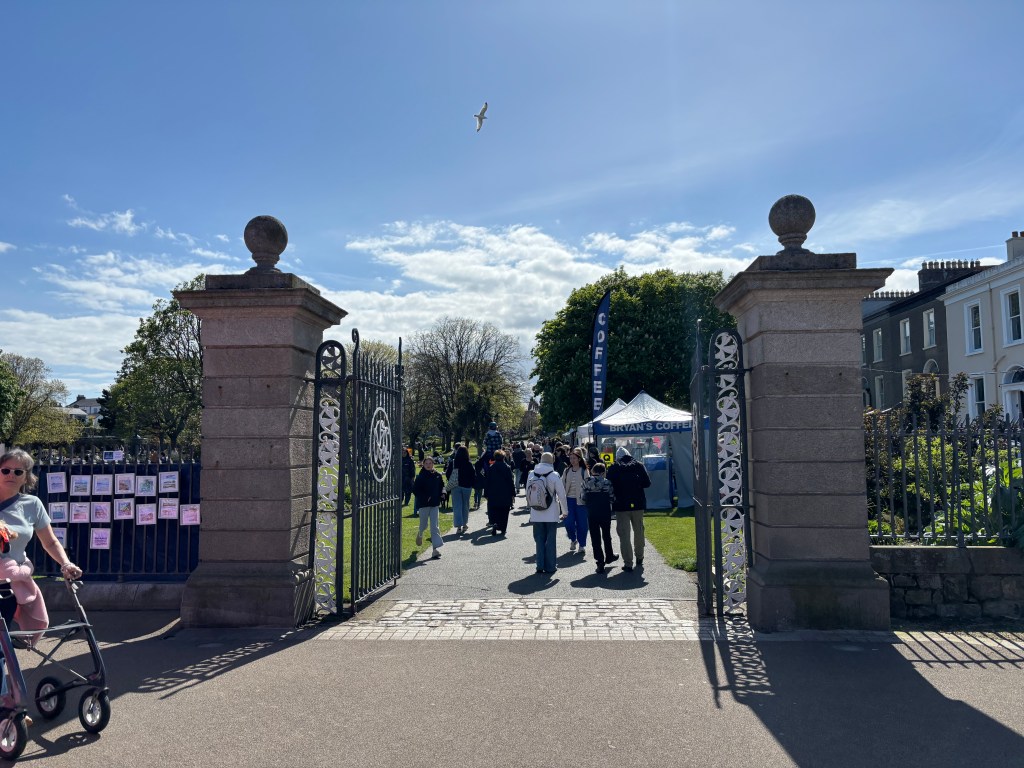
Now, if we consider that the closest town to the estates is Meryton, this further supports this spatial and social translation. Rather than a metropolitan center like Dublin or London, Meryton is an accessible site (with the girls walking there many times throughout the novel) of everyday interaction; a place of shops, encounters and informal surveillance. In contemporary terms, this dynamic is reflected in areas such as Dun Laoighire, where commercial spaces, cofffee shops and public amenities create a hub for social life. Much like Meryton, it is a space not just defined by exclusitiviy, but by visibility. With places like Oakberry and Wetherspoons it caters to the Lydias of our time, and things like the peoples-park- market, high quality coffee shops like Bibi’s and walking the peer cater to the likings of older generations. These spaces, while more accessible than the exclusive drawing rooms of the Regency elite, nonetheless replicate patterns of seperation. I could imagine ELizabeth Bennet being concerned about getting her 10k steps in, walking around the markets with Jane.
Promenading is still sexy (but only if they do it)
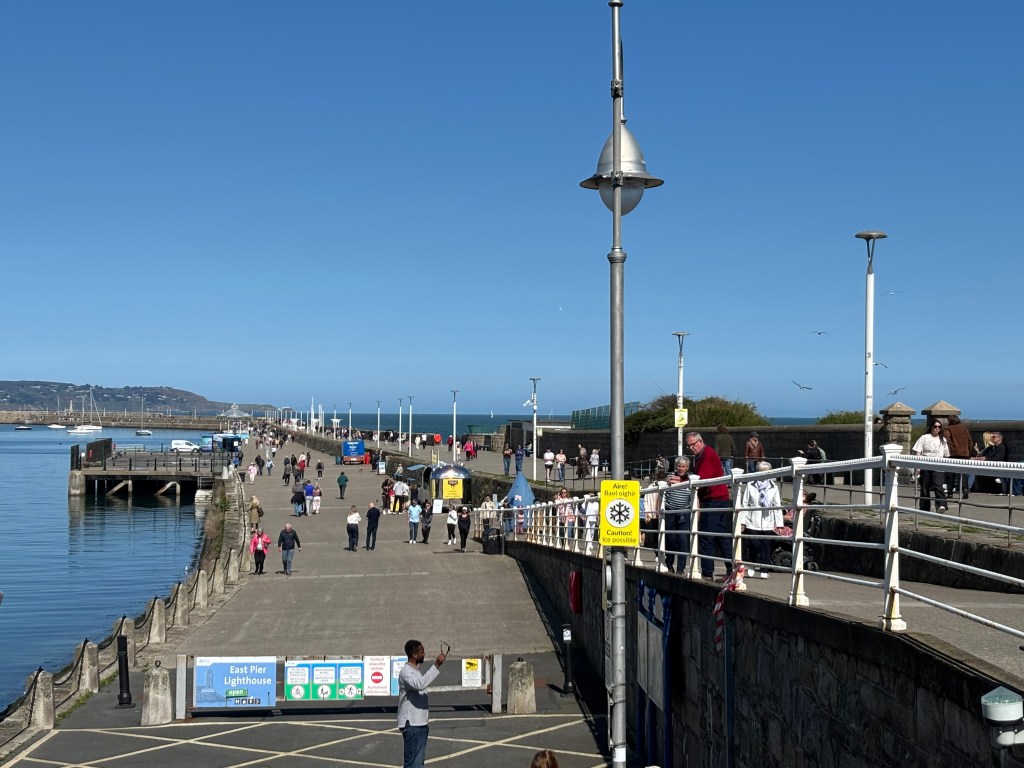
What this means is: certain social practices simply persists in altered forms. The Regency practice of promenading “was chiefly for purposes of social, economic and sexual display” (Murphy 132), and finds its contemporary equivalent in patterns of consumption and exercise. Priorly described, coffee shops, markets and workout classes function as spaces of visibility, where identity is performed through purchasing power: “These orders, Bourdieu argues, are closely interconnected through the role that different class-based principles of taste play in organizing the cultural values and practices through which classes organize, symbolize and enact their differences from one another.” (20). So hobbies divide classes- not everyone can be in a 300€ Lululemon set doing Hot Yoga in Dun Laoighire every weekend (Lydia would). These things do not even have to be perceived right in the moment anymore; if Mr Wickham wouldn’t show up to a party nowadays, after Elizabeth had gotten especially ready just for him, she would probably post a story on Instagram. Aeshethtics are much more accessible to the elite. In this sense, the marriage market has not disappeared, but has been reconfigured into a culture of economic and classist display, which seems to say: we are privileged enough to engage in expensive hobbies and leisure.
Can you purchase privacy? Yeah, thought so.
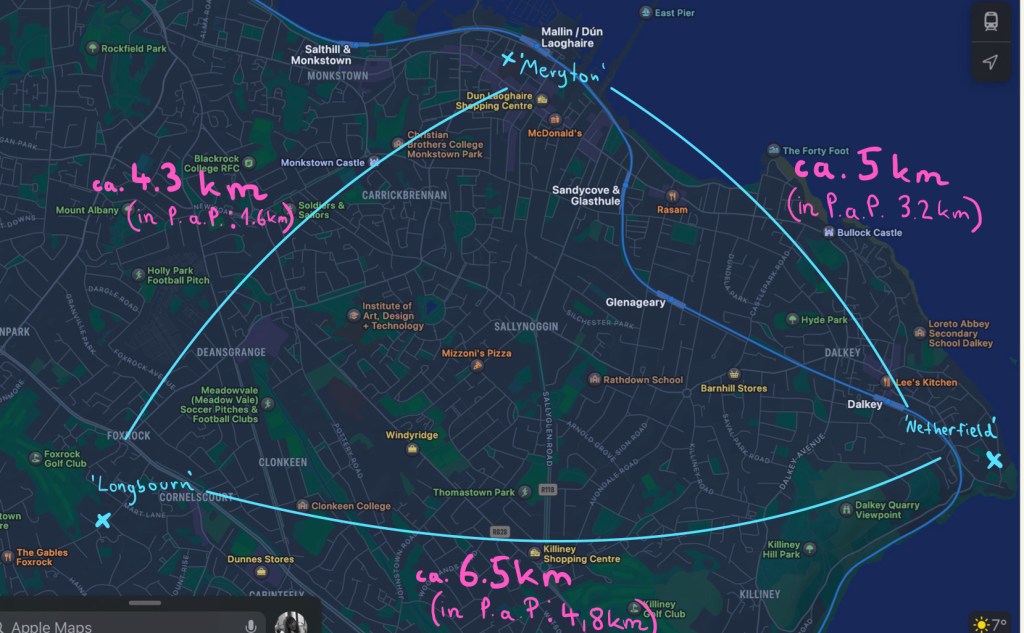
One notable divergence between Austen’s world and contemporary Dublin lies in the mathematics of distance. The physical proximity between the estates and town in the novel contrasts the bigger spatial and financial separation of modern suburbs such as Dalkey, Dun Laoighire and Foxrock . Culture has changed, so has the housing market. While privacy was already valued in the regency era, in a time of remote work, accessibility through cars, and the rise of suburban and semi- gated communities, proximity is no longer a necessity for maintaining social networks. The privilege of being able to reside further from centers of activity while retaining full access to them signals economic and social automony that allows upper-class people to distance themselves from lower financial clusters. Privacy, in both contexts, remains entirely based on wealth; the distances chosen in this blog simply mirror a modern adaption of Austen’s chosen distances.
“Let’s just get a taxi, I got my dad’s card”
How to overcome these distances is another important point. Mobility, continues to function as a visible indicator of class. In Pride and Prejudice, the Bennet’s ownership of a carriage signifies stability and legitimacy: In contemporary Dublin, this form of mobility is not that tied to ownership alone anymore and more to the immediacy of movement. While high-end cars remain a status symbol, the frequent use of taxis among South Dublin’s upper class reflects a comparable privilege: converting financial capital into convenience. Mobility is a performative symbol of class distinction, with richer people demonstrating how they can navigate space without constraint. Additionally, transport had just become “cheaper, quicker and more widely available, enabled walking to be seen as a pleasurable alternative to other modes of travel.” (Murphy 124). This can be seen in Elizabeth’s privilege of seeing walking as fun and not necessary- she was already challenging social norms by walking alone as a woman- “the potential for walking to be negatively interpreted was compounded by the association of female walking with sexual transgression.” (130). However, Elizabeth can get away with it because of her being upper class. Nowadays, she would be free to exercise and run wherever she pleases-even if she wanted to walk all the way to Dalkey to visit sickly Jane (Not something many would ever consider doing, to be sure).
“Just work harder and I’m sure you’ll be able to afford a real Stanley cup soon”
One last key distinction lies in the contemporary expansion of the middle class, which has reshaped social infrastructure. The society surrounding the Bennet’s concentrates interaction within a relatively narrow elite, yet the fall from riches into poverty under them isn’t far in the Regency Era. As Hume argues, “today a much higher percentage of the population has buying power far above bare survival level than was true in the eighteenth and early nineteenth centuries.” (302). It might be easier performing a more affluent lifestyle nowadays with knock-offs, social media and the whole beauty industry flourishing, but classism is cruel, to say it in Ms. Bingley’s words: “ (an accomplished woman) must possess a certain something in her air and manner” (Austen). An air of money and good ‘breeding’, to be exact- and the lack of working class characters in Pride and Prejudice reflects how they spend the their time; they are gentry with leisure time, while other people were working. Distance, and timing, and with that, classes, remain divided.
Some Things Never Change- And It’s Always Social Hierachies

Reimagining Pride and Prejudice within suburban Dublin ultimately reveals the persistence of class separation and privilege throughout the centuries. While the tight proximity of Austen’s world has given way to the greater distances of modern suburbia, this shift reflects changes in how privilege is expressed, with distance itself being a marker of wealth, enabled by mobility and the ability to access social spaces without dependence on proximity. Social practices have evolved since the Regency Era, with capitalism dominating our world today. Promenading, dancing, hosting- these things find their contemporary equivalent in patterns of consumption. Urban environments function as sites where the aesthetic of an identity is performed, which makes class distinction visible.
The comparison demonstrates that while forms of social interactions have changed, the same hierarchies and performance of class remain rooted within society. Austen’s world stays wit us in its structures, more than some if us might ever notice.
Works Cited
Austen, Jane. Pride and Prejudice. Project Gutenberg, 2008.
Bourdieu, Pierre. Distinction: A Social Critique of the Judgement of Taste. Harvard University Press, 1984.
Central Statistics Office. “Household Income by Region.” Geographical Profiles of Income in Ireland 2022,
https://www.cso.ie/en/releasesandpublications/fp/fp-gpiihi/geographicalprofilesofincomeinireland2022-householdincome/householdincomebyregion/. Accessed 19 Apr. 2026.
”Dublin Southside”. Apple Maps, Apple. Accessed 20 Apr. 2026.
Frey, Hanna. Coffee-queue at People Park Market. 19 Apr. 2026. Author’s Personal Collection.
Frey, Hanna. People’s Park Market. 19 Apr. 2026. Author’s Personal Collection.
Frey, Hanna. Walking on Dun Laoighire’s Peer. 19 Apr. 2026. Author’s Personal Collection.
Frey, Hanna. Bennet Sisters Enjoying the Market- Except Mary, of course. 19 April. 2026. Author’s Personal Collection.
“Foxrock.” Trips.ie, https://trips.ie/foxrock/. Accessed 18 Apr. 2026.
Hume, Robert D. “Money in Jane Austen.”
Murphy, Olivia. “Jane Austen’s ‘Excellent Walker’: Pride, Prejudice, and Pedestrianism.” Eighteenth-Century Fiction, vol. 26, no. 1, 2013, pp. 121–142.
“Sandycove Is Ireland’s Most Expensive Neighbourhood.” TheJournal.ie, June 2018,
https://www.thejournal.ie/sandycove-most-expensive-neighbourhood-4072695-Jun2018/. Accessed 20 Apr. 2026.
“The Silicon Valley of Europe.” Education in Ireland,
https://www.educationinireland.com/en/why-study-in-ireland/silicon-valley-of-europe. Accessed 20 Apr. 2026.
Toran, Emma. “The Economics of Pride and Prejudice.” Persuasions Online, vol. 36, no. 1, 2015,
https://jasna.org/publications-2/persuasions-online/vol36no1/toran/. Accessed 20 Apr. 2026.
 The Sea of Books