
Or: Why sales figures don’t always give the best indication of what the Victorians were reading
If you’re a long-term reader of this blog, you’re probably familiar with its authors’ fascination with reading cultures. We’re aware that many of our readers found their way here for the numbers: maybe you urgently needed to know which was the best-selling horse book of the nineteenth century, or you want to recreate the Victorian reading experience by working your way through the bestselling novels of the 1800s. (You’ll want to grab the complete works of Walter Scott, if so.)
Of course, you might just be reading the blog for the historical insults, in which case carry on, you flaming floundering fool.
Our series of posts on nineteenth-century book sales figures (parts 1, 2, 3 and 4) was prompted by the lack of an easily accessible source of information on this topic. Pulling together information from a few different sources, we were able to create a ranking of sorts, and although we don’t have complete data by any means, it seems that the public have found these posts really helpful. As we looked into the question of what were the most widely read nineteenth-century novels, however, we discovered that sales figures weren’t an accurate guide: books were so expensive that most people couldn’t afford them. Throughout the 1800s, rather than buying volumes of fiction, most nineteenth-century readers (at least in Britain and Ireland) got access to the latest novels by reading them as serials, by buying second-hand copies, or by borrowing them from the circulating library.
Everything you ever wanted to know about nineteenth-century library catalogues (but were too afraid to ask)
Commercial libraries like Smith’s, Boots, and Mudie’s, were an important part of the publishing industry, buying new books in bulk, and circulating them to a huge number of readers. These were huge and very influential corporations in their day: Smith’s would eventually become the newsagent chain W. H. Smith, and Boots changed gear to become the modern pharmacy chain. Mudie’s, which for a long time was the largest of these libraries, had such a big collection of titles that they regularly had to reprint their catalogue as a book in its own right, which they then sold to subscribers.

Mudie’s wasn’t just a distributor of books, although it did this on a grand scale, both around Britain and across the British Empire. It also positioned itself as a judge of quality, “protecting” its subscribers from poor-quality or disreputable novels, and (in theory, at least) making sure that the best books were made available to as many readers as possible, and providing an early platform for writers like George Eliot, Elizabeth Gaskell, Anthony Trollope, and the Bronte sisters, among many other names you may have heard of. Famously, the library also got on the wrong side of a few writers by refusing to stock their books. In one example, after Mudie’s had allegedly refused to stock his novel A Modern Lover, the Irish novelist George Moore wrote indignantly to the Pall Mall Gazette that “the literary battle of our time lies not between the romantic and the realistic schools of fiction, but for freedom from the illiterate censorship of a librarian”.
![A pen-and-ink sketch on yellowed paper. George Moore is a young man with curly light-coloured hair and a goatee, wearing a jacket over a shirt with a dark, loosely-knotted tie, and a bowler hat. He is pictured sitting at a table in a cafe, with an empty glass in front of him. His chin leans on his right elbow and he is looking to the left, perhaps speaking or about to speak.]](https://theseaofbooks.com/wp-content/uploads/2025/03/edouard_manet_george_moore_cafe.jpg?w=1024)
When I found out how many of the library’s catalogues still survive, I became intrigued by the idea of what they could teach us about how readers got their books in the nineteenth and early 20th centuries. Was it really impossible, as some have argued, to survive as a novelist if Mudie’s wouldn’t stock your book, and did they really prevent racy literature from getting into the hands of the Victorian era’s innocent young maidens?
(Spoiler warning: yes and no – but it’s complicated!)
Exploring the nineteenth-century circulating library by the data
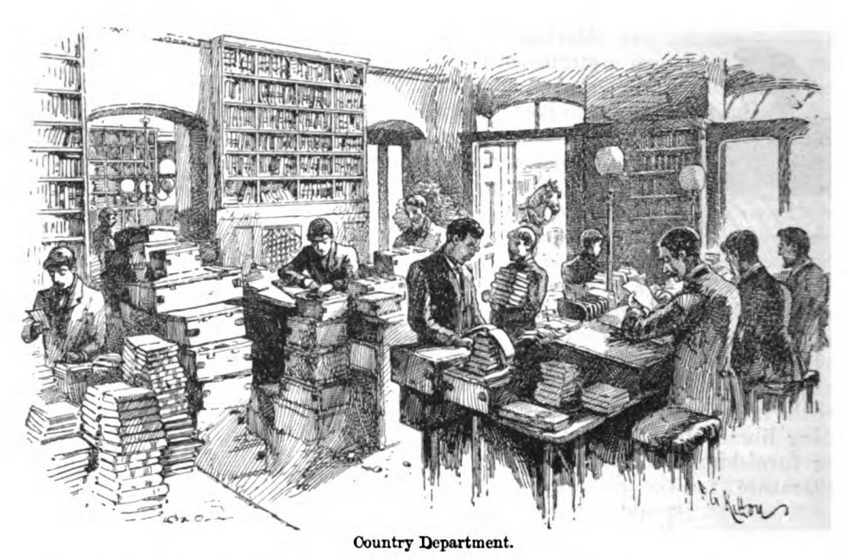
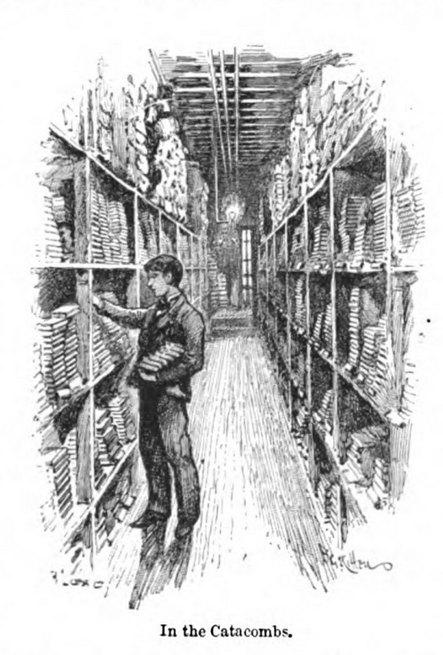
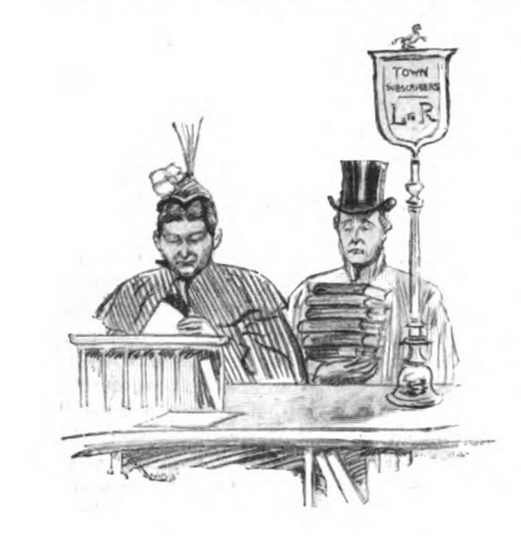
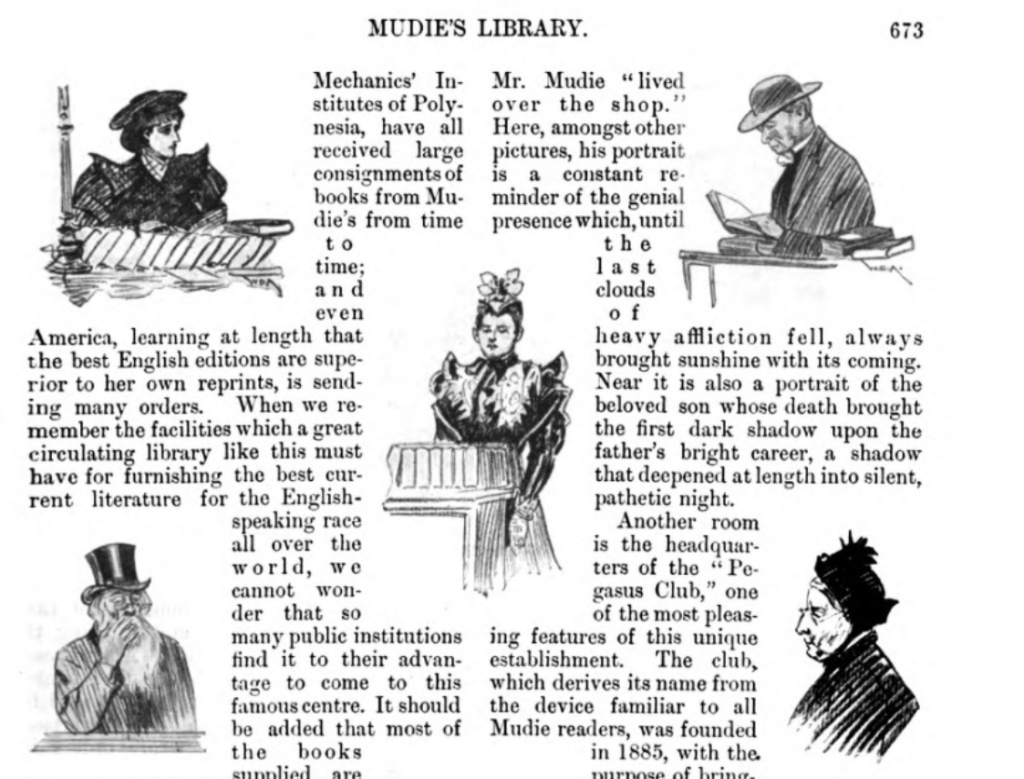
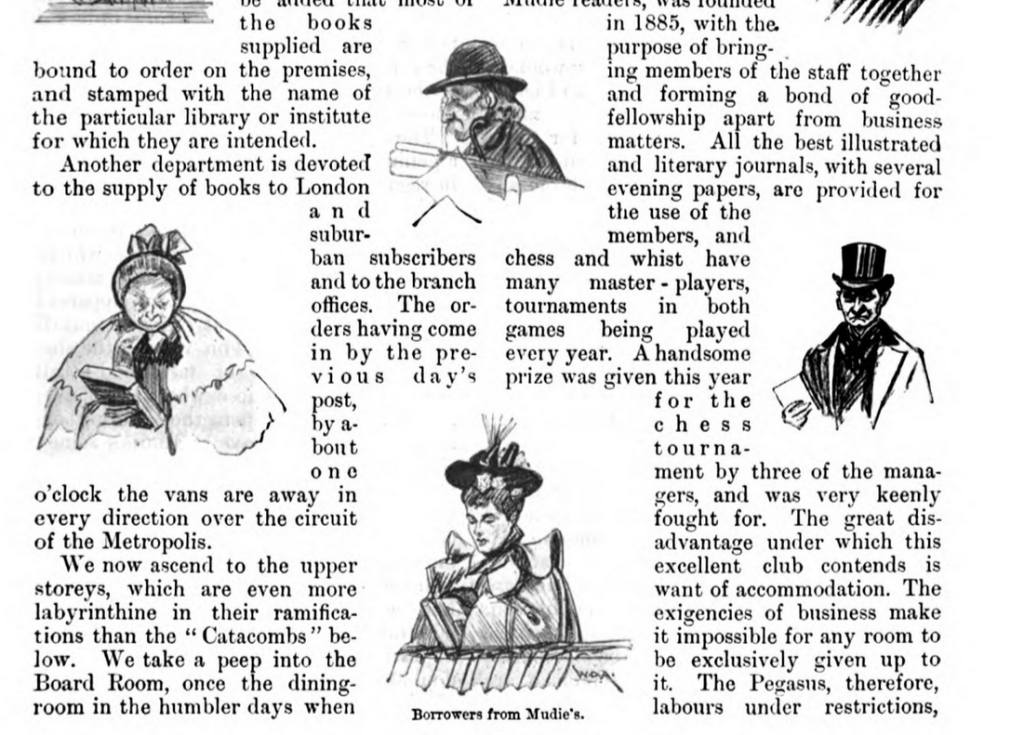
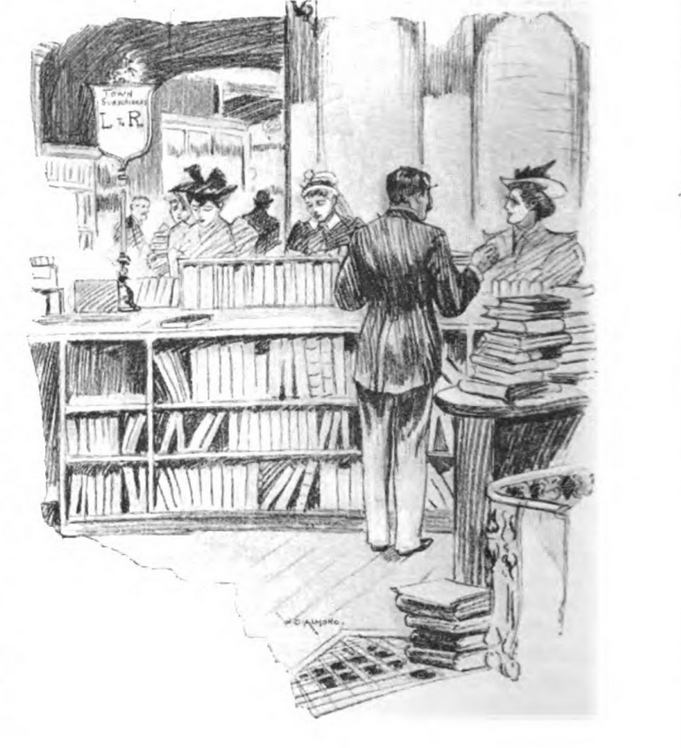
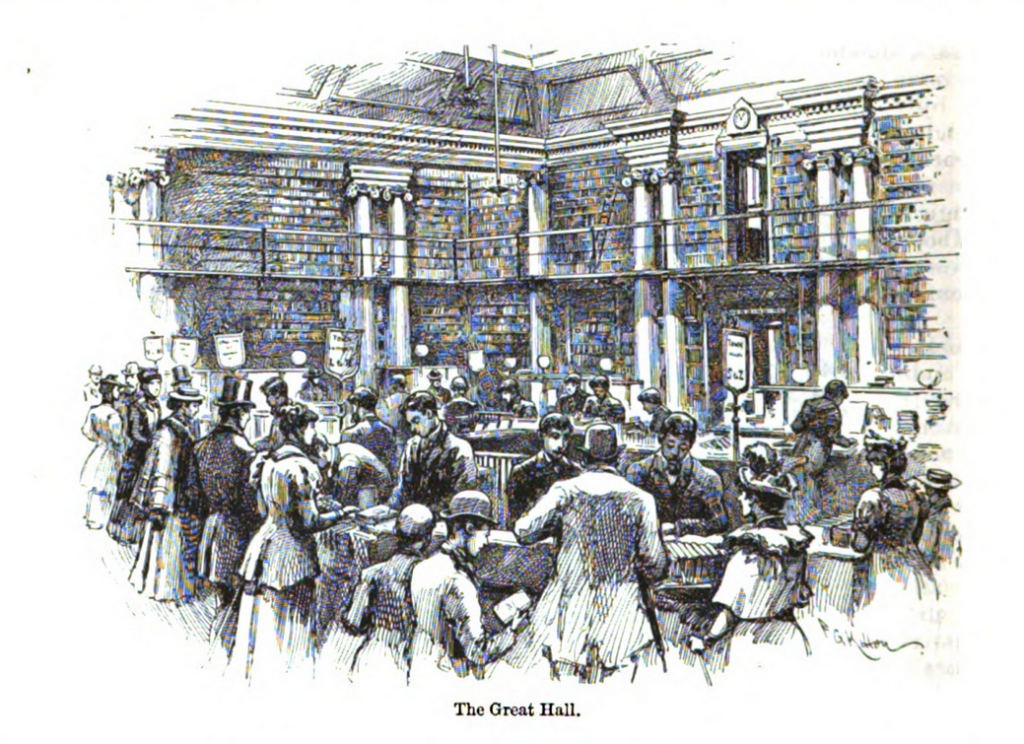
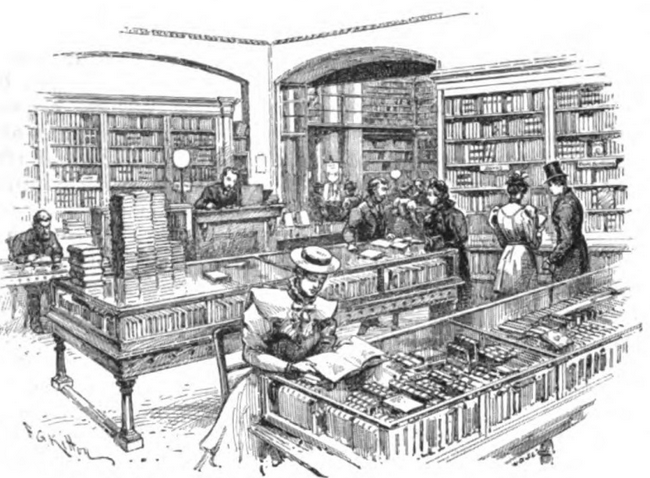
Gallery: Some contemporary illustrations from an 1894 article on Mudie’s by William C. Preston, showing the library and its customers in its heyday.
Over the course of several years, myself and members of my team at the UCD Centre for Cultural Analytics have painstakingly created a digital Mudie’s catalogue from some of the surviving copies. These range from a little pamphlet which the library printed in 1848, to a massive 760-page-long catalogue, complete with an index of categories such as “Sea Life: Piratical” and “Occultism: Ghosts and Hauntings”, which they published in 1907.
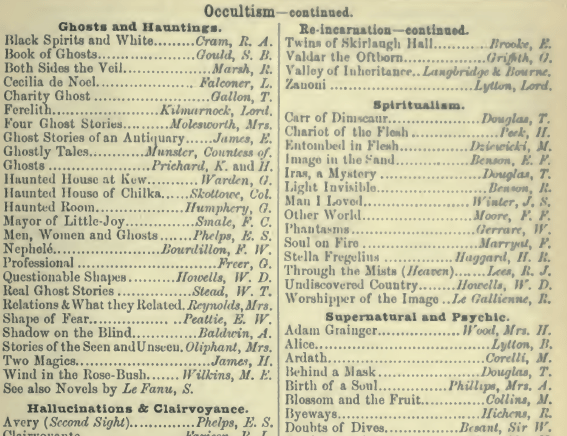
We used this to create a searchable database, Mudie’s Library Online, where you can look up books by your favourite nineteenth-century author, and see when (and if!) they could be checked out of Mudie’s. Our data is available as an open-access dataset, which you can download from Harvard Dataverse.
I also wrote a book!

Mudie’s Select Library and the Shelf Life of the Nineteenth Century Novel looks at how books and novelists fared in the library across the course of the nineteenth century. It’s intended for students and researchers working in nineteenth-century literature, or for anyone with an interest in this area, and as an open-access publication, it’s available free through Cambridge Core.
Please feel free to download the book as a PDF, or even to order a hard copy if you feel so inclined!
And to sum up, I’ll finish with one of my favourite quotes about the library, which comes from Albert Kevill-Davies’s 1892 novel Miss Blanchard of Chicago:
‘…Mudie supplies us with all our worldly and spiritual knowledge, barring what we pick up from our morning paper. We read everything – theological works, theosophic works, translations of the ancients, like Homer and Cicero, essays on Socialism, histories of heathen religions and society novels.’
‘By Jove! what a pot-pourri; and which is most to your taste?’
‘That depends much upon my frame of mind and the weather, but I fear my taste is so far demoralised as to experience the greatest amount of enjoyment in a really good novel.’Miss Blanchard of Chicago (1892), Albert Kevill-Davies
For more information on the book, you can watch my video abstract:


#/media/File:Edouard_Manet_George_Moore_Cafe.jpg)
4 Comments Add yours